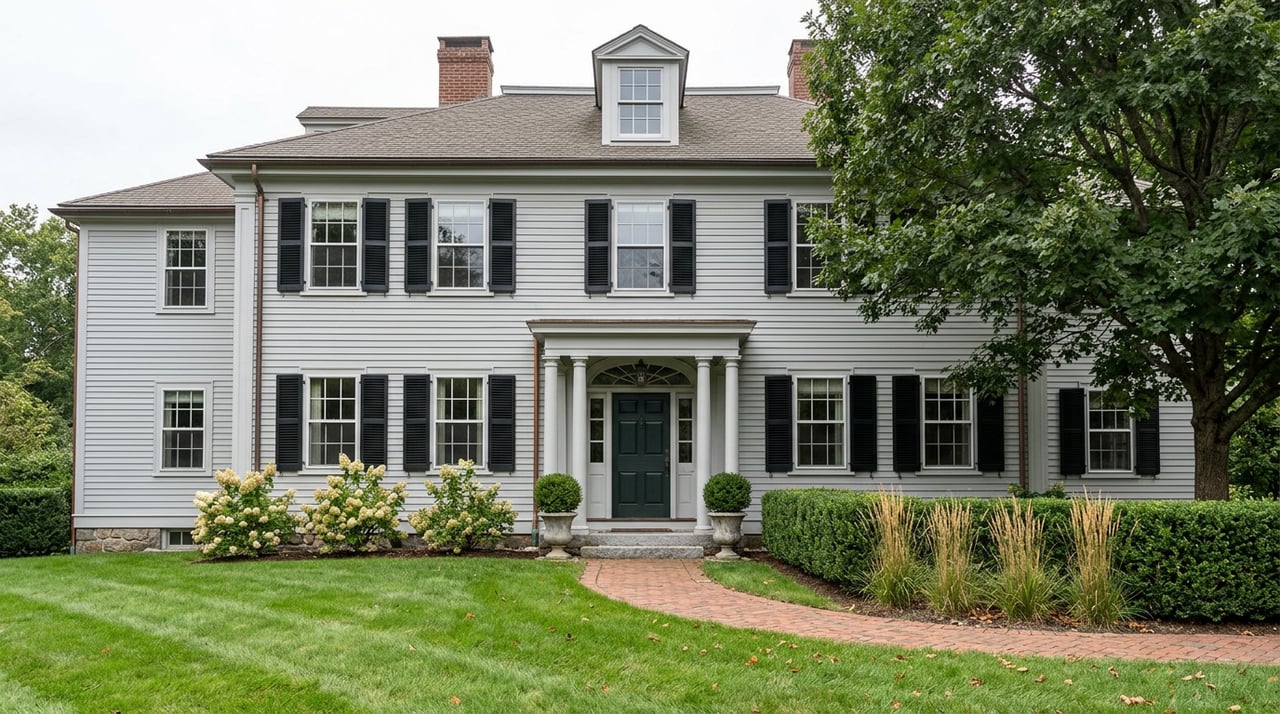
A buyer under agreement on a Federal-era half-house near Market Square recently asked her contractor for a straightforward scope: new kitchen windows, a rebuilt rear dormer, maybe six weeks of work before she moved in. The contractor came back with a different number. Depending on which side of the property line the dormer fell on, the project could clear in a matter of weeks, or it could sit in front of a city board for the better part of a year. Same house, same "historic district" label on the listing sheet, two entirely different outcomes.
That gap is the thing most buyers and sellers get wrong about Newburyport's historic core. The city's National Register Historic District covers more than 2,900 contributing structures, according to the Newburyport Preservation Trust, which means the overwhelming majority of homes on High Street, in the South End, and around downtown carry the label. But the label itself does almost nothing. What actually governs your renovation depends on which of three separate review systems your specific address falls under, and only one of them functions as true design control.
Three Systems, Not One
Here is what each one actually does, and who holds the pen.
| Regime | What triggers it | Who decides | What it means for you |
|---|---|---|---|
| Demolition Delay Ordinance (citywide) | Applying for a demolition permit on a primary structure 75 years or older, or an accessory structure 100 years or older | Newburyport Historical Commission, an all-volunteer board that meets twice a month | If the Commission finds the structure "preferably preserved," demolition may be delayed |
| Demolition Control Overlay District (DCOD) | Exterior wall demolition exceeding 25 percent of a wall, or any roofline change on a qualifying structure | Zoning Board of Appeals, which acts as the Special Permit Granting Authority while weighing an advisory report from the Historical Commission | This is where most real renovations actually get tested. Light interior work and in-kind window replacement in existing openings don't trigger it at all |
| Local Historic District, such as Fruit Street | Some visible exterior changes require review | The district's own commission, in Fruit Street's case established in 2007 | A fundamentally different animal from the rest of downtown |
Notice what is missing from that table: a single "Newburyport Historic District Commission" with authority over every old house in the city. It does not exist as a blanket power. What exists is a demolition-focused review board, a threshold-based overlay that only activates once you cross a specific line, and a small number of genuinely binding local districts that most buyers have never heard of until they are already under agreement.
The Number That Actually Decides Your Timeline
The Demolition Control Overlay District guidance published by the city's Planning Department spells out the math plainly. If a structure is listed as "Contributing" in the Newburyport Historic District Data Sheets, demolishing more than 25 percent of a single exterior wall triggers DCOD review. Cross that line, or change the roofline on a structure old enough to qualify, and the Zoning Board of Appeals becomes the approval authority for the project, weighing an advisory Historical Report from the Historical Commission along the way.
Stay under that 25 percent threshold and leave the roofline unchanged, and DCOD review never activates. Replace windows in their existing openings without additional structural work, and neither the Historical Commission nor the ZBA gets involved. This is the calculation a buyer needs before writing an offer on a renovation project, not after: will the scope stay under the 25 percent threshold with the roofline unchanged, or will it trigger DCOD review by crossing that threshold or changing the roofline and pull the ZBA into your timeline?
Demolition Delay Still Matters
On May 11, 2026, the Newburyport City Council voted 9-2 on amended Ordinance 217. Newburyport Historical Commission vice chair Chris Sawtelle argued during the hearing that the change would work because the Commission typically imposes delay at an applicant's initial hearing and meets twice monthly, making its process more efficient than comparable towns. Jared Eigerman, speaking for the Newburyport Preservation Trust, reminded the council that the underlying ordinance dates to 2005 and was built to protect significant buildings, not every structure that happens to be old.
The threshold itself did not move. It still applies to primary structures 75 years or older and accessory structures 100 years or older, the same age bands that predate the amendment. Council discussion on the measure ran across three separate meetings in March, April, and May before the vote, according to reporting on the Council's action, which gives some sense of how closely the city is watching this issue right now.
One Street Where the Rules Are Actually Binding
Fruit Street is the clearest example of what a true Local Historic District looks like in Newburyport, and it is worth understanding precisely because it is the exception, not the rule. Established in 2007, the Fruit Street Historic District has its own commission that reviews some proposed exterior changes on properties within its boundary. If your house sits inside that boundary, you are operating under a different set of expectations than a buyer three streets away in the broader National Register district, even though both listings will likely use the word "historic."
The Preservation Trust's own resource guide lists nine named historic sub-districts inside the larger National Register area, including Chestnut Street, High Street, Joppa, the South End, and the Merrimac Street Shipbuilding District. Most of these are documentation categories, useful for understanding a house's architectural pedigree, not independent approval authorities. Fruit Street is the outlier with real teeth. Before you assume a property carries binding design review, or assume it doesn't, it is worth confirming which category it actually falls into.
What This Costs at the Table
Price bands across Newburyport's older neighborhoods, as tracked in the city's own neighborhood guide, give a sense of what buyers are weighing against this regulatory picture as of early 2026:
- Condominiums in converted Federal-era buildings in the historic core: roughly $400,000 to $900,000
- Single-family homes in the South End and other walkable historic streets: typically $850,000 to $1.3 million for turnkey properties
- High Street historic estates, the city's prestige corridor: $1.5 million to $4 million and up
- Waterfront or river-view properties with a private dock: $2 million to $4 million and up, the rarest category in the market
The citywide median single-family sale price for full-year 2025 landed at $1.1 million, according to The Warren Group's annual Massachusetts housing data, with homes averaging 27 to 29 days on market. That pace matters here because a buyer who assumes a light cosmetic refresh will discover, once the contractor pulls measurements, that they are actually proposing a scope that crosses the DCOD threshold, and the closing timeline they budgeted no longer matches the renovation timeline they are actually facing.
The debate over how much latitude new construction should get inside these older neighborhoods is not theoretical. At a Planning & Development Committee meeting on February 3, 2026, a Zoning Board of Appeals member with six years on the board observed that the city's current zoning "fits the Turkey Hill neighborhood but not the historic district," which effectively makes the ZBA the referee on a case-by-case basis rather than working from clear standing rules. The same discussion flagged concern about what participants termed "mansionization," new builds scaled larger than the historic lot patterns around them. A $3.5 million new-construction home listed on Beacon Avenue in the South End has been cited locally as an example of that trend meeting the city's older lot fabric head on. For anyone eyeing a teardown-candidate lot in the South End or near High Street, that unsettled zoning conversation is worth factoring into both pricing expectations and timeline before making an offer.
One more procedural note worth building into any offer on an older Newburyport home: under the Massachusetts Inspection Law (760 CMR 74), effective October 2025, sellers can no longer accept offers that waive a buyer's inspection rights. Budget an additional 7 to 10 days for the inspection period on any historic property, and consider a specialized structural and moisture assessment for anything on High Street or in the South End's older housing stock, since general home inspectors do not always carry that specific expertise.
A Few Questions Worth Answering Before You Offer
Does every old house in Newburyport need Historical Commission approval to renovate? No. Most renovations that stay under the 25 percent exterior wall threshold and don't touch the roofline never reach the Commission or the Zoning Board of Appeals at all. The Demolition Delay Ordinance only activates when someone files for an actual demolition permit.
How do I find out if a property sits inside a binding Local Historic District like Fruit Street? The city's boundary maps and the Newburyport Preservation Trust's district pages are the starting point, and confirming status before writing an offer saves real time later.
Does the demolition delay apply to every house 75 years or older? The age threshold applies broadly, but delay is only invoked once the Historical Commission determines a specific structure is "preferably preserved" during its review, not automatically for every qualifying building.
Buying or selling an older Newburyport home means understanding which of these three systems actually governs the specific address in question, not the neighborhood's reputation for being historic. That distinction is exactly the kind of contract detail worth having an attorney's eye on before you sign anything. If you are weighing a purchase or a sale inside Newburyport's historic core, Alissa Christie can walk through what applies to your specific property before you're under agreement. Let's Connect.
This article is general information, not legal, tax or financial advice. Consult a qualified professional about your situation.